There are people who know how to dream, and others who have the courage to give up everything and start over to make their dreams come true. This is the case of Svetoslav Ponchev, a 28-year-old originally from Plovdiv, a historic city in Bulgaria, who five years ago decided to dedicate his life to his homeland, moving to the small village of Stefanovo, a few kilometers south of the capital, Sofia. His goal? To revive the local community and send a signal to institutions that some young people want to stay, that all is not lost, and that even a few seeds can grow into something great.
After meeting him in person during a European Solidarity Corps training course, in which he participated as a member of the Green Association, founded in 2012 and active in Stefanovo for the past three years, Svetoslav agreed to tell his story. Over friendly conversation, in the middle of the dining hall of an elegant hotel in Sofia, we discussed Bulgarian and European agricultural policies, and the hopes, obstacles, and dreams of a small portion of young people in this corner of Eastern Europe.
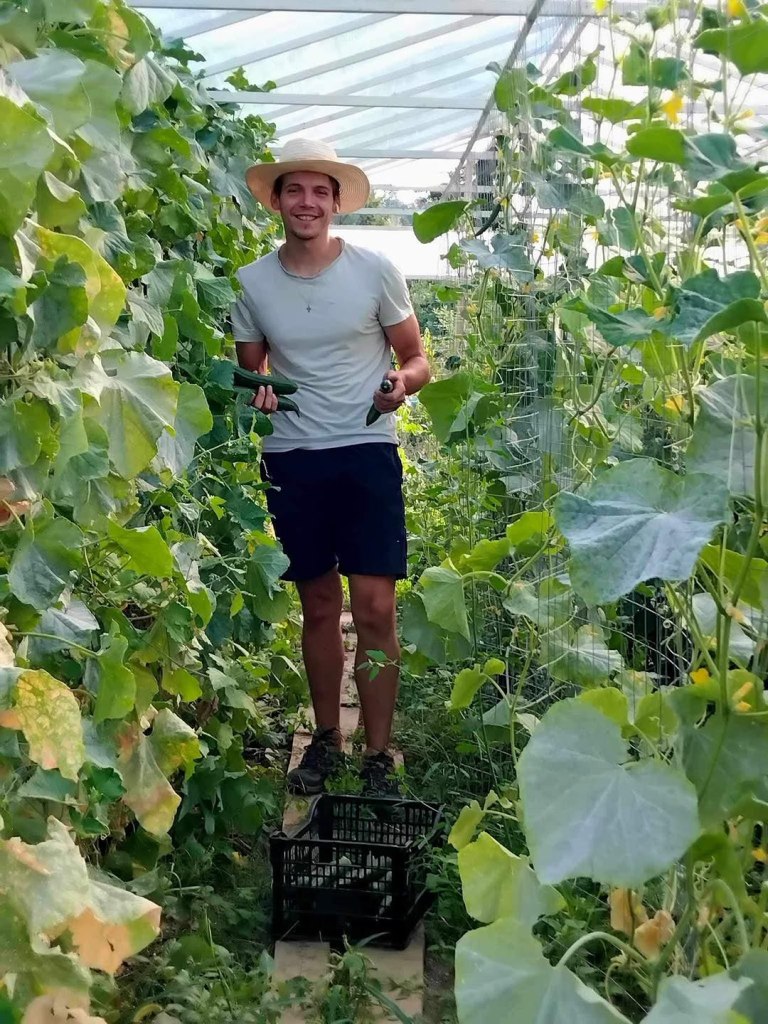
Janette: Thank you so much for accepting to do this interview. I’m sure not a lot of people will read it so please, don’t be nervous. First thing first, I’d like you to tell us the story of how you ended up moving your entire life to a small farm in rural Bulgaria.
Svetoslav: More than ten years ago, I had a dream: to find a place in Bulgaria where I could buy land, build a house, and grow my own food. I wanted to live off-grid, with solar panels, my own water supply, the whole thing. So, I started traveling around the country, visiting different communities that were trying to do something similar. Some focused on cultural projects, others on farming, but I was mainly observing how they were organized. Were they sustainable? Could people afford to live there without relying on outside income?
With time, I noticed that none of the communities I visited were truly self-sufficient. They all depended on donations or external funding, and most people still worked regular salaried jobs outside the project. I kept asking myself: Where is the problem? Why isn’t this working?
Then one day I was invited to volunteer on a roof-repair project at the farm where I now live. I helped, and afterward the people there asked me, “You helped us, so how can we help you?” I told them about my dream. They asked if I already had land or a place in mind. I didn’t.
The owner of the farm (an old, wise man) made a suggestion. He said, “Why don’t you stay for a month and see how it feels? Many people think they want a certain lifestyle, but when they experience it, they find out it’s not for them.”
He was right. Living in a village is very different from living in a city. So, I accepted his invitation to try it for a month. I ended up staying for a year. During that time, I helped with all kinds of work on the farm. I did agricultural tasks even though I had no farming background, and I learned by doing. That year showed me not only what off-grid life really looks like, but also that this dream was truly mine.
Janette: But that first year was like a volunteering experience?
Svetoslav: Not exactly. It was volunteering, but not in the formal sense. They simply covered my basic needs, like food, accommodation, everything essential, but it wasn’t an organized volunteer program like they have now.
Their idea was simple. They had this large farm, and they were looking for someone who could eventually take over the agricultural side of things. The place is big, with old buildings they’ve been restoring and developing, but there was no one who could really continue the farming work. They needed someone for that.
But at that time (this was about five years ago) I was more interested in building. I loved construction work, helping with renovations and projects around the farm. I didn’t enjoy agriculture much. It was tough. When you must go out and plant 4,000 tomato sticks, it’s hard work. The first day I thought, “Ah, I’ll manage this in two hours.” Two weeks later I realized that no, it’s not an easy job at all. By the tenth stick you’re already thinking, What have I gotten myself into?
So, I stayed for a year, and then I left. At that moment, it didn’t feel like my dream anymore. The farm felt more like a burden than the life I was imagining for myself. If you accept that kind of responsibility, you really have to commit. You’re basically tied to the farm for five or six years at minimum, and back then, I wasn’t ready for that. So, I left. I went abroad to work and travel. I spent three years in Denmark, and from there I had the chance to visit many countries around Europe. It was a new kind of exploration, seeing how people lived and how things worked in different places. After a while, I felt satisfied. I’d seen enough.
That’s when I realized I wanted something to anchor me, something that would keep me in one place and allow me to build things slowly, layer by layer. I thought, Maybe it’s time to go back to the farm. I asked if they had space for me again, and I spoke with the old man who runs the farm. He suggested we do a one-year test period, to see how it works for both sides and to let me experience the full agricultural cycle. So that’s what we did. The cycle ended and after completing it, I created my own project.
Janette: When you first arrived at the farm, you said you weren’t really interested in agriculture, you preferred building and construction work. What changed? What made you shift toward agriculture?
Svetoslav: Well, there were a few reasons. First of all, I’ve had back problems for years. I’ve worked hard physical jobs in my life, and the heaviest work I ever did was in Denmark. After that, I started having serious lower back issues. So I thought, I need to do something softer on my body, but with better technology and better methods. That was one part of it.
But agriculture has another side that really drew me in. It gives you the chance to experiment and to actually see the full process, from the seed to the plant, to the fruit. It’s amazing. Each year you can observe how things grow and how they change. There’s something very satisfying about that.
At the beginning, maybe it looked like I was more interested in building. And I was, at that time. But interests change. You’re passionate about something for a while, then it decreases, and something else rises. It’s not that you love one thing forever.
For me, agriculture works in cycles. I was here once, I learned everything I could from that cycle, then life moved on and I moved with it. When the cycle brought me back, I suddenly felt that interest again, even stronger, actually. Now I’m much more devoted to it.
Janette: So now I’m going to ask you about a topic I honestly don’t know much about. It’s related to Bulgarian farming policies. In your opinion, what is the biggest challenge for farmers in Bulgaria when it comes to national policies? And what could be improved?
Svetoslav: Here in Bulgaria, the main problem is how subsidies are distributed. The big producers, the ones growing wheat, sunflower, and corn, take the biggest piece of the pie. Imagine a huge cake: they get almost all of it. This has been happening ever since Bulgaria joined the European Union. Billions and billions of euros have gone to them.
And when these large farmers receive their subsidies, they use the money to buy more land. Every year they expand. We even have one man here who owns 100,000 hectares, just one person. There’s hardly another place in the world where an individual controls that much farmland.
So, in my view, the first issue is the European Commission’s policy approach. They effectively divided Europe into zones: the South should produce certain crops, the North others, and so on. But that’s completely wrong. It limits diversity, reduces resilience, and prevents countries like Bulgaria from developing balanced agricultural sectors.
For example, when it comes to vegetables, we simply can’t compete or produce enough under the current system. The subsidies and structure all favour the large monoculture crops, not diversified vegetable farming.
Janette: Let’s look at the bigger picture now. You mentioned the European Commission. I’m sure that you’re familiar with the Common Agricultural Policy. What’s your opinion on the kind of policies and the policy-making process in the EU when it comes to agriculture and farming?
Svetoslav: The problem is that the people who make these policies are bureaucrats, and we are the farmers. Those bureaucrats have never been in the real field. They’ve never stepped in the mud with their shoes, never felt what the work actually is. Yet they decide everything.
In Bulgaria, like in many countries, 90% of the agricultural economy is based on just a few things: crops, cattle, milk, and that’s it. And people complain because the whole system pushes farmers in that direction.
This happened because the Commission made a huge mistake years ago: they paid farmers based on land. The bigger the land, the more money you got. So of course, it’s good for someone to have 1,000 hectares of wheat. It’s cheap to produce wheat on that much land, and you can scale faster than producing 1,000 hectares of tomatoes. Tomatoes require a lot of manual labour. Wheat only needs big machines. And the subsidies helped farmers buy those big machines.
For about 15 years the Commission followed this model. And eventually they realized it was a mistake. A big one. Now they’re trying to change it. They still pay per land, but it’s limited. They’re trying to push a different approach, but it will take time to fix what they created.
Janette: Earlier you mentioned sustainability. After the Green Deal, there have been a lot of discussions between farmers and policymakers across Europe. In your opinion, for small Bulgarian farmers, is the Green Deal more of a burden, more of a help, or neither?
Svetoslav: Here in Bulgaria, it’s not really a thing yet. It’s too hard to follow. The people who actually try to follow the European Commission’s rules struggle a lot. For us, the Green Deal could maybe work in ten years, but not now. We’re not ready.
Janette: Okay, so if the Green Deal can’t work immediately, what can we do to bring more sustainability to small Bulgarian farms?
Svetoslav: First of all, reduce bureaucracy. You can’t imagine how many different kinds of papers I have to fill out and fill out again, and again. I can manage them because I’m young and I understand the rules and clauses. But the average age of farmers in Europe is 57 years old. Many of these people don’t even know how to use email. The bureaucracy is terrible, and they aren’t reducing it. For example, I practice biological agriculture, regenerative agriculture, and for that I need certification. A company comes to inspect me. They take samples from every crop, every field, to prove that I’m not using pesticides or artificial fertilizers. That’s one process. Then I have to apply for subsidies, another complicated process. And it goes on like this.
Janette: If you could give, let’s say, three tips, or maybe three reality checks, to policymakers in Bulgaria and in the European Union regarding all these issues, what would they be?
Svetoslav: Less bureaucracy, definitely. And also: let farmers just be farmers. Because here, to be a farmer, you also have to be a salesman. You need to find your own market. There’s no central place where you can sell all your products. Instead, resellers come to you and say, “I’ll give you 20 stotinki for your tomatoes,” which is nothing, and then they sell them for 3 leva. That’s the system.
The positive side is that the European Commission is trying now to make things easier, especially to encourage more young farmers. They have programs that subsidize young people who want to start agriculture. For example, I will apply for the Young Farmer Program in January 2026. They give you 40,000 euros over five years to help you develop your farm. For Bulgaria, that’s a good amount.
I’ve also read that the Commission wants to encourage more young people across Europe to start farming. But the situation is very different from country to country. In Bulgaria, starting a farm is actually cheaper than in many Western countries, because land here isn’t expensive. One hectare costs around 7.000 euros, which is manageable. In Italy or Luxembourg, you need 40.000 or 50.000 euros for the same amount of land. That’s a huge difference.
So yes, there are pros and cons. I started with my own savings. I don’t rely on subsidies, for me they’re just a bonus if they happen, because you can’t depend on them. They might approve you, but then they delay the payment. So it’s good to have support as an option, but not as your foundation.
That’s why I’m focused on developing my own strategy to reach people. And I already have many ideas. For example, I’ve talked with several people who are interested in collaborating in different ways. My idea is that it’s one thing to reach the local market, but Bulgaria also has many foreigners living here. So how do I reach them? Through other foreigners. That’s what I’m working on now.
Janette: Since we’ve been talking a lot about young people, especially those who might want to start a farming career, what’s a piece of advice you wish someone had given you before you started? Something you’d like other young people to know.
Svetoslav: What helped me most was what that old man did for me. He gave me a chance to see if this life was really for me. That was huge. So, my advice for young people is this: before you start anything, find a farm and go live there. Stay for at least six months. See how it really feels.
Because investing in something you don’t understand is much harder and riskier than investing in something you at least know a little about. Real, hands-on experience is everything.
But there’s also a difference between being in a “test period” and being responsible for your own farm. During my test year, I felt free, because if I made a mistake, someone else could fix it. But when you’re on your own, you feel the weight of responsibility. Everything depends on your actions. If you don’t wake up early to irrigate, you can ruin an entire section of your production.
So my advice is: test it first, understand the responsibility, and only then decide if it’s truly the life you want.
 The Concordian
Leave a comment